
A Love Song for Grown Hearts That Realized Too Late How Little We Truly Understand
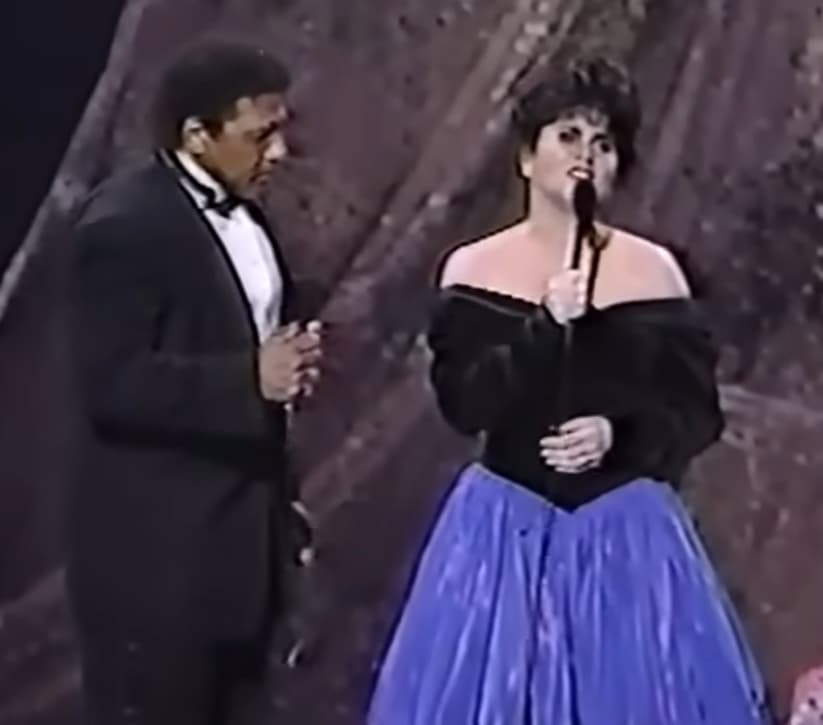
When Linda Ronstadt and Aaron Neville brought “Don’t Know Much” back into the public consciousness in 1989—later immortalized in unforgettable live performances throughout 1990—they transformed a modest 1980 composition into one of the era’s most emotionally devastating adult duets. Featured on Ronstadt’s platinum-selling album Cry Like a Rainstorm, Howl Like the Wind, the song climbed to No. 2 on the Billboard Hot 100 and became an international success, earning widespread acclaim for the extraordinary chemistry between two voices that seemed born from entirely different worlds. Ronstadt carried the weathered elegance of California country-rock sophistication; Neville arrived with the trembling vulnerability of New Orleans soul. Together, they sounded less like performers and more like two souls confessing under dim light after a lifetime of emotional detours.
What made “Don’t Know Much” extraordinary was never complexity. In fact, the song’s entire emotional architecture rests upon simplicity. Its narrator admits ignorance again and again—I don’t know much about history, biology, science books—but the repetition is not comic or naïve. It is existential. The song quietly dismantles the illusion that intelligence, education, or worldly experience can protect a person from emotional uncertainty. By the time Neville reaches those aching upper-register phrases, trembling as though every word costs him something personal, the listener understands the true confession at the heart of the song: love remains the one subject no one ever fully masters.
The live renditions from 1990 revealed something even deeper than the studio recording. Onstage, there was restraint—almost painful restraint. Ronstadt did not oversing. Neville did not dramatize. They allowed silence and fragility to carry the emotional weight. That discipline is precisely why the performances endure decades later. Many duets attempt passion through theatrical intensity; “Don’t Know Much” achieved it through emotional honesty. The pauses between lines felt as important as the lines themselves. Their eye contact, subtle timing, and hesitant phrasing created the sensation of two adults rediscovering tenderness after years spent protecting themselves from disappointment.
Musically, the arrangement belongs to a tradition that had nearly vanished by the close of the 1980s: the sophisticated adult ballad built on patience rather than spectacle. The piano never rushes. The strings swell carefully instead of exploding into sentimentality. Every production choice leaves room for the voices, and those voices carry the scars of real life. Ronstadt sings with graceful certainty, while Neville’s famously quivering tenor introduces vulnerability into every syllable. The contrast becomes the emotional engine of the song itself. She sounds like someone trying to hold love together; he sounds like someone terrified it may disappear.
There is also a subtle cultural resonance behind the song’s enduring legacy. At the dawn of the 1990s, mainstream pop increasingly leaned toward image, velocity, and commercial excess. Yet “Don’t Know Much” became a massive hit by moving in the opposite direction. It invited listeners to slow down and confront emotional humility. The song suggested that maturity was not about having answers—it was about recognizing the limits of certainty. That message resonated profoundly with audiences who had already lived through heartbreak, divorce, compromise, and regret.
Decades later, the live performances remain timeless because they speak to an audience rarely addressed in popular music: adults who understand that love is not fantasy, but endurance. Linda Ronstadt and Aaron Neville did not sing about youthful obsession. They sang about the terrifying beauty of admitting emotional dependence after experience has taught you how fragile happiness can be. That is why “Don’t Know Much” still feels intimate today. It does not attempt to impress the listener. It simply tells the truth—quietly, elegantly, and without protection.