
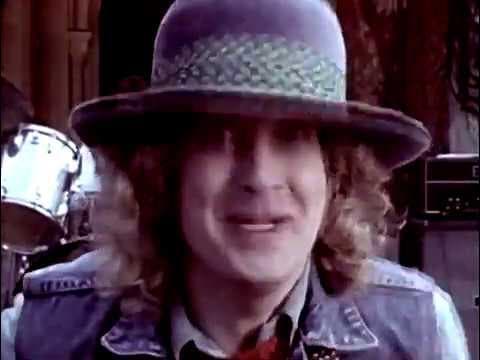
A runaway anthem for the restless heart, carrying Celtic fire through the last great roar of arena rock.
When Slade released “Run Runaway” in early 1984, the song did more than revive a legendary band’s commercial fortunes—it reminded the world that raw, communal rock music still had blood in its veins. Lifted from the album The Amazing Kamikaze Syndrome, the single climbed to No. 7 on the UK Singles Chart and later broke through in America, reaching No. 20 on the Billboard Hot 100 while topping Billboard’s Rock Tracks chart. For a group many critics had already filed away as relics of the glam-rock era, the success of “Run Runaway” felt less like a comeback and more like a vindication.
What makes the song endure is the peculiar way it refuses to belong entirely to one decade. Beneath its pounding drums and roaring guitars lies something older—almost ancient in spirit. Jim Lea’s electric violin gives the track its unmistakable Celtic pulse, transforming what could have been a straightforward hard-rock single into something resembling a battle march for modern wanderers. The rhythm gallops rather than grooves. It surges forward with the momentum of escape itself.
And escape is the song’s emotional center.
Unlike many rock anthems of the early 1980s, “Run Runaway” does not celebrate rebellion in the cartoonish sense. It speaks instead to exhaustion—the instinctive human urge to flee disappointment, emotional confinement, or the slow suffocation of routine. Noddy Holder’s voice, forever rough-edged and defiant, sounds less like a polished frontman and more like a man shouting above a storm. There is urgency in every chorus, but also loneliness. The repeated command to “run runaway” becomes almost existential by the final refrain, as though motion itself is the only remaining form of survival.
Part of the song’s power comes from timing. By 1984, musical culture had changed dramatically from the stomping glam era that first made Slade famous. Synth-pop dominated the charts, MTV was reshaping visual identity, and many seventies rock bands struggled to sound relevant without sacrificing themselves completely. Yet “Run Runaway” succeeded precisely because it did not chase fashion too desperately. Instead, it amplified the band’s original strengths—working-class energy, giant hooks, and unpretentious emotional release—while adding a cinematic scale suited to the new decade.
The accompanying video, heavily rotated on MTV, helped introduce younger American audiences to a band they often knew only indirectly through covers by acts like Quiet Riot. Suddenly, listeners discovered the source rather than the imitation.
Decades later, the song still carries the sensation of cold air against the face. It feels built for highways at dusk, crowded pubs singing in unison, or solitary moments when life becomes too narrow and the soul begins searching for open country again. That is why “Run Runaway” survives beyond nostalgia. It captures a universal impulse: the desire to outrun fear before fear becomes identity.
In the end, the song was not merely a hit record for Slade. It was proof that even after years of changing trends and fading headlines, a band could still summon thunder when it mattered most.