
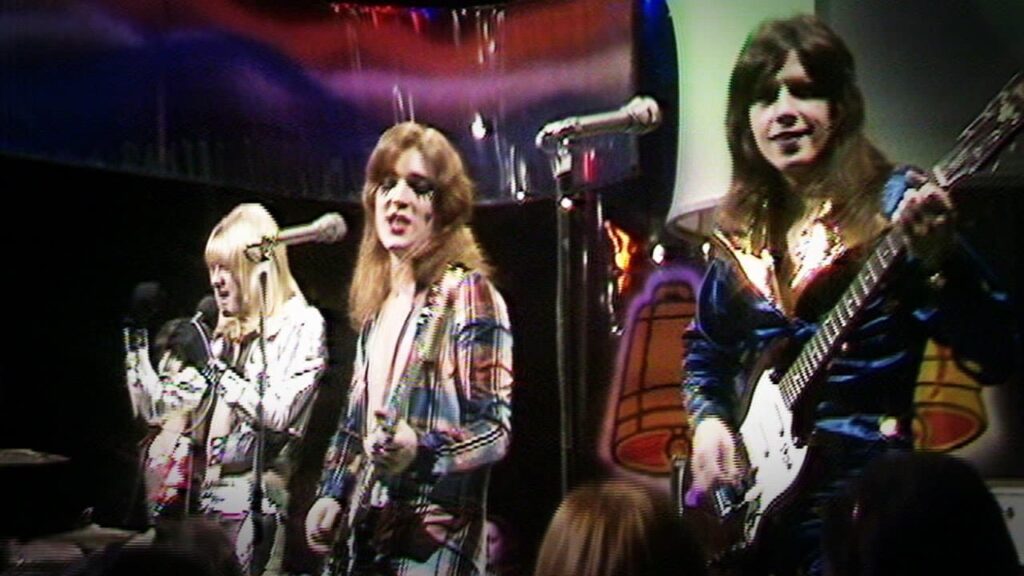
A siren, a stomp, and the sound of glam rock taking complete control of the British charts
When Sweet stormed onto television screens with “Block Buster!” on Top of the Pops in January 1973, glam rock had already begun tightening its grip on Britain, but this single turned that movement into something impossible to ignore. Released as a standalone single and later associated with versions of The Sweet, the song became the band’s only UK No. 1 hit, remaining at the top of the charts for five consecutive weeks in early 1973 and opening the year with one of the loudest statements British pop music had heard in years.
The brilliance of “Block Buster!” lies in how unapologetically theatrical it is. Before a lyric is even sung, the track erupts with a police siren, immediately creating tension, danger, and excitement. It feels less like a pop song beginning and more like the opening scene of a street chase in some neon soaked fantasy version of Britain. Then comes that grinding riff, thick with swagger and menace, followed by Brian Connolly’s commanding vocal delivery. Nothing about it asks politely for attention. It takes it.
By 1973, Sweet had already established themselves as masters of glitter coated pop rebellion, guided by the songwriting partnership of Nicky Chinn and Mike Chapman. Yet “Block Buster!” pushed further into hard rock territory than many of their earlier hits. Beneath the platform boots and flamboyant image was a genuinely aggressive rhythm section. Mick Tucker’s drumming hits like heavy machinery, while Steve Priest’s bass gives the song its dangerous pulse. The record balanced pop accessibility with raw force, which became one of the defining characteristics of glam rock at its peak.
Much has been said over the years about the similarity between the song’s riff and David Bowie’s “The Jean Genie.” The comparison followed the band almost immediately after release. But history has softened that debate, largely because “Block Buster!” ultimately carved out its own identity. Where Bowie’s track slithered with bluesy coolness, Sweet sounded explosive and confrontational. The song was not subtle art rock. It was working class adrenaline dressed in glitter.
Lyrically, the song thrives on mystery. “Buster” is never fully explained. He becomes more symbol than character, a looming presence moving through the city after dark. That ambiguity gives the track its strange power. It captures the paranoia and excitement of youth culture in the early seventies, where danger and attraction often walked side by side. The repeated warnings in the chorus feel almost playful, but there is genuine tension underneath them. It is music built on anticipation.
The famous Top of the Pops performances only amplified that atmosphere. In an era when television exposure could transform a song into national obsession overnight, Sweet understood spectacle better than almost anyone. Glitter makeup, dramatic poses, loud guitars, and absolute confidence turned them into visual icons of the glam era. Yet beneath all the visual excess was a remarkably disciplined pop record. Every hook lands precisely where it should. Every chorus feels engineered for mass hysteria.
More than fifty years later, “Block Buster!” still sounds alive because it captures a moment when British rock stopped trying to appear respectable. It embraced noise, style, fantasy, and excess all at once. Few records announce themselves with such immediate force. Fewer still continue to sound this thrilling decades later.