
Glitter, innocence, and rebellion collided in one of glam rock’s most deliriously unforgettable singalongs.
When Sweet released “Wig-Wam Bam” in September 1972, the single did far more than climb the charts. It announced a transformation. The song surged to No. 4 on the UK Singles Chart and became one of the defining records of Britain’s glam rock explosion. Released during the transitional era between bubblegum pop and heavier theatrical rock, the track later appeared on The Sweet’s Biggest Hits and stood as an early sign that Sweet were becoming something far larger than a singles act. Behind the absurd title and candy colored energy was a band discovering its identity in real time.
There is a beautiful contradiction at the center of “Wig-Wam Bam.” On the surface, it sounds playful, almost cartoonish. The lyrics tumble forward with references to Hiawatha, Minnehaha, and childhood fantasy imagery, all wrapped inside pounding drums, stacked harmonies, and glitter coated hooks. Yet beneath the novelty lies something essential to early 1970s British youth culture. Glam rock was never only about spectacle. It was about escape. Britain was economically uncertain, socially exhausted, and emotionally gray. Songs like this arrived like neon lights against a dark winter sky.
What makes the record endure is not lyrical complexity but attitude. The opening chant feels less like a traditional rock introduction and more like a gang invitation into another world. Brian Connolly’s vocal carries a mischievous swagger, while the production by Phil Wainman keeps every handclap and guitar accent razor sharp. The song moves with the confidence of musicians who understand that pop music does not always need realism to communicate truth. Sometimes exaggeration reveals emotion more honestly than confession ever could.
Historically, “Wig-Wam Bam” also marked an important turning point for Sweet themselves. Earlier recordings often relied heavily on session musicians, but this period began showcasing the band’s own instrumental personality more directly. That matters because the record captures the exact moment when Sweet stopped feeling manufactured and started sounding dangerous. The guitars became thicker. The rhythm section gained muscle. Steve Priest’s theatrical presence began shaping the group’s identity as much as the songwriting partnership of Nicky Chinn and Mike Chapman.
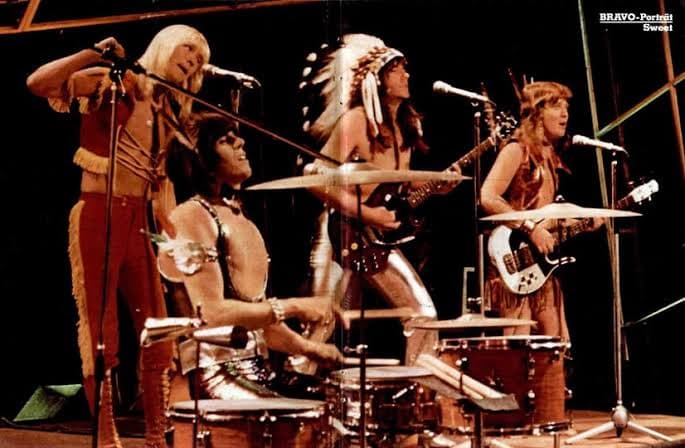
Watching the surviving footage from Top Of The Pops in 1972 now feels almost surreal. Feathered costumes, platform boots, makeup, impossible hair. Yet the chaos was calculated. Glam rock understood performance as liberation. Masculinity could become flamboyant. Pop could become absurd. Rock music no longer needed to pretend it was serious to be culturally important.
And that may be the lasting brilliance of “Wig-Wam Bam.” It never asks permission to be outrageous. It embraces excess with a grin wide enough to swallow the entire room. Decades later, the song still sounds like a transmission from a world where glitter was armor and joy itself felt rebellious.
For many listeners, that three minute burst of glam fantasy remains one of the purest snapshots of what early 1970s British pop could achieve when imagination overpowered restraint.