
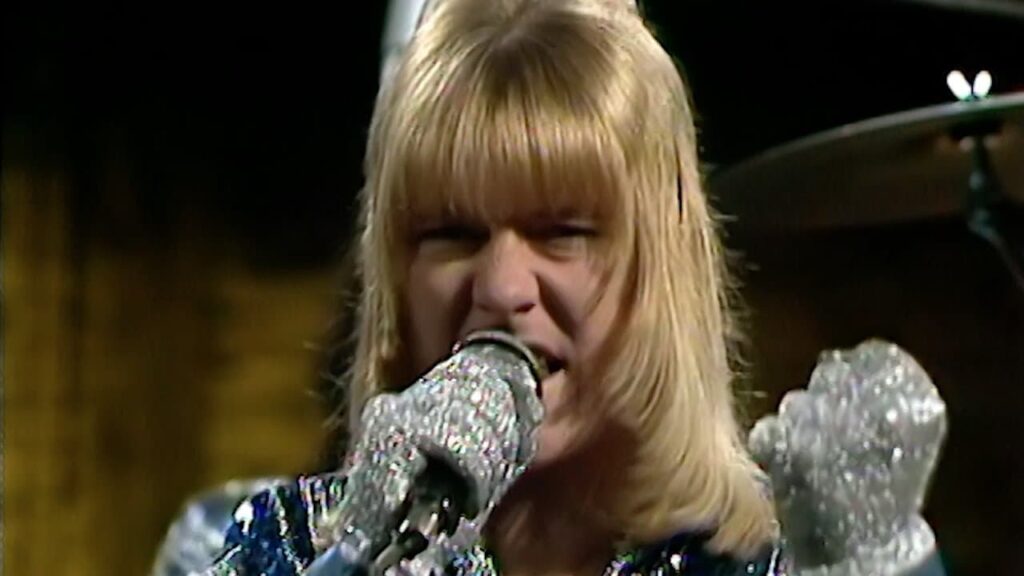
A BAND ON THE EDGE OF REINVENTION TURNED GLAMOUR INTO SOMETHING FAR DARKER AND FAR MORE DANGEROUS
When Sweet stepped onto the stage of Germany’s legendary television program Musikladen on February 20, 1974, they were no longer content to remain the glitter-coated hitmakers the public thought they understood. Their performance of “Sweet F.A.”, drawn from the fiercely ambitious 1974 album Sweet Fanny Adams, arrived during a crucial turning point in the band’s history. While the song itself was never designed as a major chart single, the album became one of the defining records of their career, reaching No. 27 on the UK Albums Chart and climbing as high as No. 2 in West Germany. More importantly, it announced that Sweet were evolving beyond bubblegum glam into a heavier, more volatile hard rock force.
That transformation is etched into every second of “Sweet F.A.”. The title itself carried a sly British vulgarity, shorthand for “Sweet Fanny Adams,” an old expression meaning absolutely nothing at all. Yet the song feels anything but empty. Beneath its swagger lies frustration, rebellion, and a barely restrained sense of chaos. It is the sound of a band tearing at the image imposed upon them by the early 1970s music industry.
For years, Sweet had been associated with enormous glam-pop singles crafted under the supervision of songwriters Nicky Chinn and Mike Chapman. Songs like Block Buster! and Ballroom Blitz made them stars, but success often came with confinement. By 1974, guitarist Andy Scott, drummer Mick Tucker, bassist Steve Priest, and vocalist Brian Connolly wanted something rougher, louder, and more authentic to their own instincts. Sweet Fanny Adams became their declaration of independence.
And nowhere is that hunger more visible than in “Sweet F.A.” itself.
The riff crashes forward with a menace absent from most glam rock of the era. Scott’s guitar work carries a proto-metal sharpness, while Tucker’s drumming swings between discipline and destruction. Connolly’s vocal performance is especially striking because it abandons polished sweetness for something almost confrontational. There is desperation in his phrasing, but also exhilaration. The song feels like four musicians discovering how dangerous they could become once they stopped trying to please everybody.
Lyrically, “Sweet F.A.” captures urban restlessness and youthful aggression with remarkable directness. There is bravado throughout the track, but also insecurity hiding beneath it. The characters in the song posture, threaten, and shout their way through the night, yet the entire atmosphere feels unstable, as though violence or heartbreak could erupt at any moment. In retrospect, the song almost predicts the raw street-level attitude that punk would soon drag into British rock music later in the decade.
That is why the Musikladen performance remains so fascinating today. It captures Sweet in transition, standing between two identities. The glitter still clings to the surface, but underneath it, the band had already become something harder and far more uncompromising. Watching them perform “Sweet F.A.” now feels less like witnessing a television appearance and more like catching the precise moment a commercially manufactured pop phenomenon broke free of its own reflection and stared directly into the darker future of rock music itself.