
A Glam-Rock Anthem That Turned Teenage Longing Into a Roaring Street-Corner Celebration
When Sweet released “Little Willy” in 1972 from the album Funny How Sweet Co-Co Can Be, the song quickly exploded beyond the British glam-rock circuit and became one of the band’s defining international breakthroughs. It climbed to No. 4 on the UK Singles Chart and later reached No. 3 on the Billboard Hot 100 in the United States, a remarkable feat for a group that many critics initially underestimated as merely a glitter-coated singles act. Yet beneath the stomping beat, handclaps, and infectious chants, “Little Willy” carried the unmistakable energy of a changing era in pop music — a moment when rock stopped trying to appear respectable and instead embraced spectacle, rebellion, and pure youthful adrenaline.
Written by the formidable songwriting partnership of Mike Chapman and Nicky Chinn, the architects behind much of Sweet’s early success, the song was engineered with precision but delivered with a rawness that made it feel spontaneous. Chapman and Chinn understood something essential about early-1970s youth culture: listeners wanted records that sounded alive. “Little Willy” does not unfold like a carefully intellectual composition. It charges forward like a neon-lit Saturday night spilling out into the streets after midnight. That is precisely why it endured.
The lyrical narrative itself is deceptively simple. Willy is portrayed almost like a restless drifter — elusive, flirtatious, impossible to pin down. The repeated pleas of “Little Willy, Willy won’t go home” become more than a catchy refrain; they evoke the image of adolescence refusing to surrender to adulthood. In another band’s hands, the lyric might have sounded disposable. But Sweet transformed it into theater. Brian Connolly’s vocal performance balances swagger with vulnerability, while the band’s layered harmonies create the illusion of an entire crowd singing along from the back row of a dance hall.
Musically, the song sits at a fascinating crossroads between bubblegum pop and hard rock. The pounding rhythm section hints at the heavier direction Sweet would later pursue on records like “Ballroom Blitz” and “Fox on the Run,” yet “Little Willy” still retains the bright hooks and singalong immediacy of late-1960s pop craftsmanship. Andy Scott’s guitar work flashes with glam flamboyance, but the arrangement never loses its discipline. Every drum accent, every backing vocal, every stomp feels calculated to ignite collective excitement.
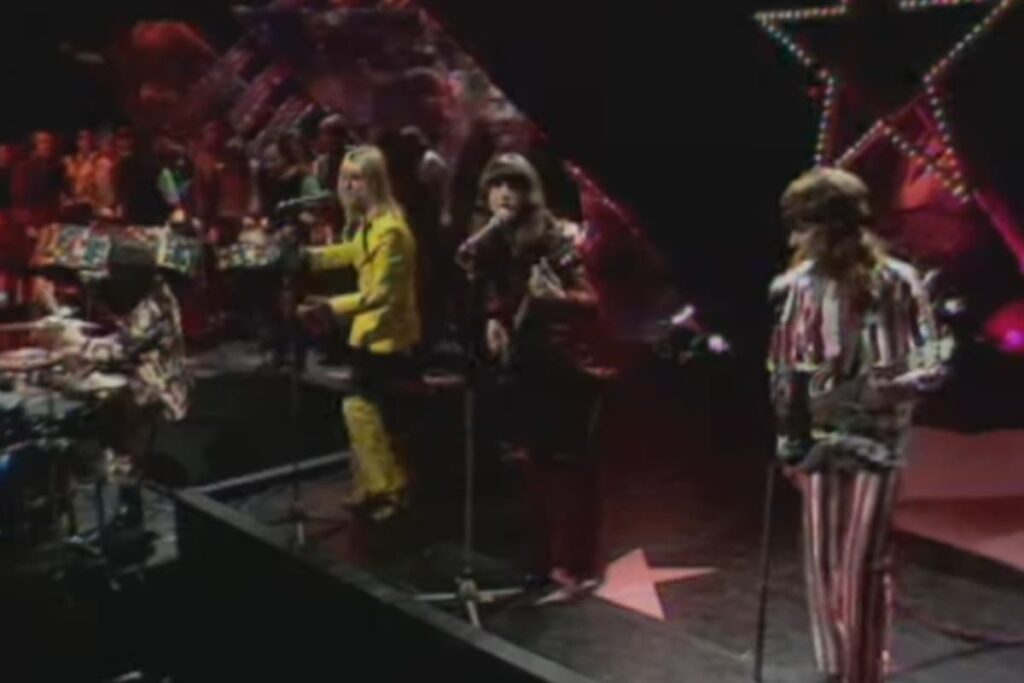
What gives the record lasting emotional power, however, is not merely its commercial polish. It is the sound of youthful chaos being immortalized before it disappears. Glam rock often gets remembered for platform boots, glitter makeup, and television appearances on programs like Top Of The Pops, but songs like “Little Willy” reveal something deeper beneath the spectacle. There is loneliness hidden inside the celebration. The central figure refuses to go home because home represents limits, routine, perhaps even the end of freedom itself. The song captures that fleeting age when the night feels endless and consequences still seem distant.
More than five decades later, “Little Willy” still bursts from speakers with astonishing vitality. It remains one of those rare records that can instantly transport listeners into the feverish pulse of early-1970s glam culture — a world of flashing lights, crowded dance floors, and young dreamers searching for one more chorus before dawn arrived.