
A Glam Rock Survivor Singing Against the Silence of Time
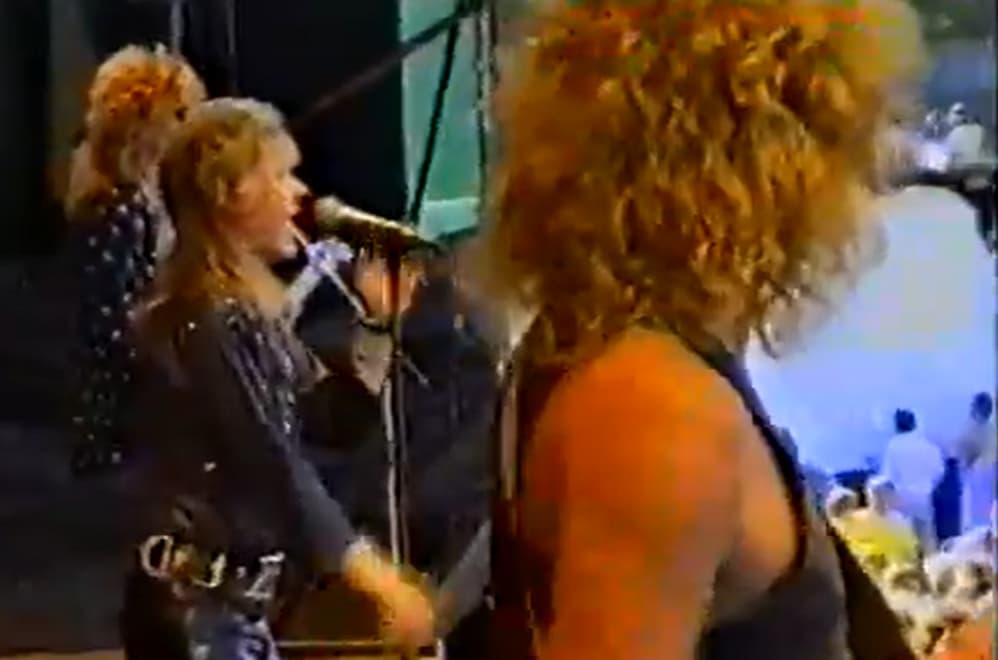
By the time Brian Connolly stood before audiences in Denmark in 1991 under the banner of The Sweet, he was no longer merely revisiting the glittering triumphs of the 1970s — he was carrying the wounded soul of glam rock itself. The performance later circulated as Sweet Live Denmark 91, capturing a period when the once-chart-dominating voice behind hits like “Ballroom Blitz,” “Fox on the Run,” and “Love Is Like Oxygen” was fighting to preserve both his legacy and his identity. During Sweet’s peak years, the band became one of Britain’s defining glam acts, scoring multiple UK Top 10 singles throughout the 1970s and achieving enormous commercial success across Europe and beyond. Yet this Danish performance belongs to a far more fragile chapter of the story — one shaped less by chart positions than by endurance.
There is something profoundly moving about listening to Connolly in these later performances. The youthful swagger that once exploded from transistor radios had aged into something rougher, heavier, and infinitely more human. Glam rock, in its heyday, often thrived on spectacle: platform boots, mirrored costumes, impossibly catchy hooks, and choruses designed to shake arenas. But time stripped away the glitter and left behind the man beneath it. What remained in Denmark in 1991 was not perfection. It was testimony.
Connolly’s voice had changed dramatically by then, shaped by years of personal struggles and physical decline. Yet that transformation gives these performances their emotional gravity. Songs that once sounded rebellious and flirtatious suddenly carried the ache of memory. When he revisited the Sweet catalog, the lyrics no longer felt like youthful declarations shouted into the night; they sounded like echoes from another lifetime, reclaimed by someone who understood exactly how fleeting fame can be.
The tragedy — and beauty — of Sweet Live Denmark 91 lies in its contrast between past and present. Audiences still came to hear the anthems that had once defined an era, but they were also witnessing the vulnerability of a performer confronting the shadow of his own mythology. Connolly had helped create some of the most infectious singles of the glam era, records built on giant riffs, theatrical harmonies, and an almost mischievous sense of escapism. Yet by the early 1990s, those songs carried a different emotional temperature. They became reflections on survival itself.
Musically, the performances still pulse with the DNA that made The Sweet unforgettable. The stomping rhythms, stacked vocal harmonies, and razor-edged guitar work remained intact, reminding listeners why the band had become such an influential force for later hard rock and glam metal acts. Long before hair metal conquered arenas in the 1980s, Sweet had already perfected the union of pop melody and hard-rock attitude. Bands across generations borrowed from that formula, whether knowingly or not.
But beyond influence or nostalgia, Sweet Live Denmark 91 endures because it reveals something rare about classic rock history: the distance between immortality and mortality. Records freeze artists in eternal youth, but live performances tell the truth. In Denmark, Brian Connolly was no longer the untouchable glam idol from magazine covers. He was a man standing in front of an audience with scars visible in both voice and posture, still singing songs that once conquered the world.
And perhaps that is why these performances resonate so deeply today. They are not simply documents of a concert. They are reminders that music often becomes most powerful not at the height of success, but in the moments when an artist refuses to disappear quietly.