
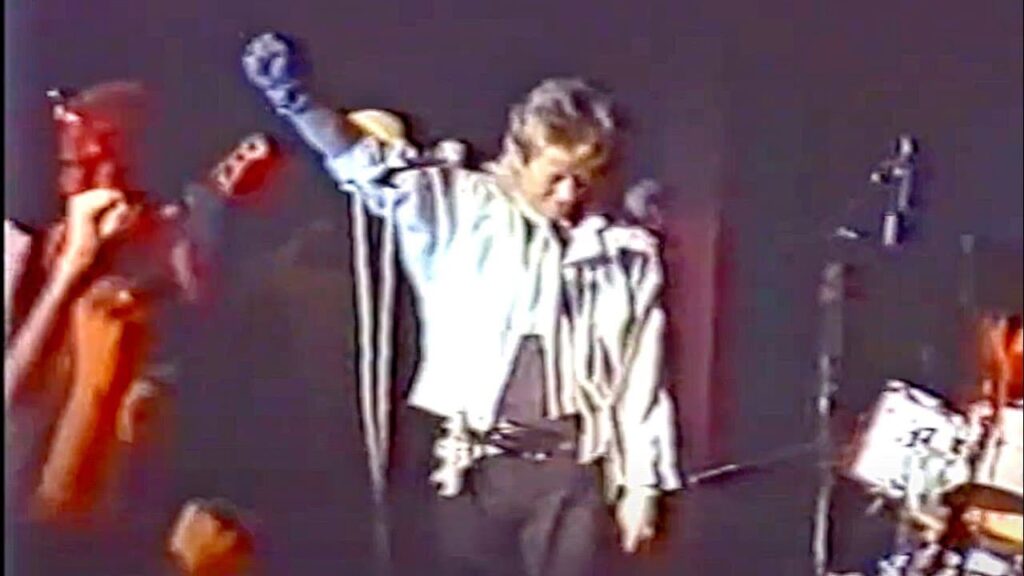
A Voice Once Built for Glamour, Now Singing Through the Ruins of Memory
By 1986, Brian Connolly was no longer standing at the center of pop culture’s blinding spotlight, yet performances like “Sweet (Brian Connolly) – Live Hanau Germany 1986” carried a different kind of gravity—one untouched by chart positions or commercial expectation. Connolly, the unmistakable voice behind Sweet, had already helped define the glitter-coated thunder of 1970s glam rock through hits from albums like Desolation Boulevard and Give Us a Wink. Songs such as “Ballroom Blitz,” “Fox on the Run,” and “Love Is Like Oxygen” had once stormed international charts, transforming Sweet into one of Britain’s most explosive singles bands. But Hanau, Germany, in 1986 was not about chart domination. It was about survival, memory, and the fragile persistence of a performer refusing to disappear quietly.
There is something deeply moving about archival concert footage from artists who have already passed through their commercial peak. The camera captures more than a setlist—it captures time itself. In Hanau, Connolly appeared far removed from the youthful swagger that once defined glam rock’s golden years. The wild-eyed theatricality of early Sweet had softened into something more human and weathered. His voice, marked by years of hardship and personal struggle, no longer soared with the effortless sharpness heard on the original records. Yet that very imperfection becomes the emotional center of the performance.
The tragedy and beauty of Brian Connolly’s later years cannot be separated from the songs themselves. Glam rock was often dismissed in its era as flashy entertainment, all platform boots and glitter. But Sweet’s greatest recordings always carried a strange emotional tension beneath the spectacle. Even their loudest hits balanced aggression with vulnerability. Connolly’s voice had an aching quality hidden beneath the hooks—a wounded sincerity buried inside music designed for arenas and teenage rebellion.
By the mid-1980s, audiences attending these smaller European performances were not simply hearing old hits. They were witnessing a man confronting the ghost of his former self in real time. Every lyric carried double meaning. Songs once written as celebrations of youth and excess now sounded almost autobiographical, transformed by age and distance. The roaring choruses that once ignited massive crowds became echoes from another decade, and that contrast gives the Hanau performance its haunting power.
Germany, in particular, remained one of the places where Sweet’s legacy endured with remarkable loyalty. European audiences often treated these concerts less like nostalgia acts and more like reunions with a lost era. The crowd response in performances from this period reveals genuine affection—not pity, but recognition. Connolly represented a surviving fragment of glam rock’s original spirit, a genre that had burned brightly and faded fast.
What makes “Sweet (Brian Connolly) – Live Hanau Germany 1986” compelling today is not technical perfection. It is the emotional honesty embedded within it. The performance stands as a document of endurance. Connolly sings not as the untouchable idol from magazine covers, but as a man carrying the weight of fame’s aftermath. In that sense, the concert becomes larger than nostalgia. It becomes a meditation on what happens after the applause fades—when the artist is left alone with the songs that once changed his life.
For listeners returning to this performance decades later, the experience can feel almost cinematic. The lights are dimmer, the venues smaller, the voice rougher. Yet somehow the humanity is greater. Brian Connolly no longer sounds like a rock star trying to conquer the world. He sounds like someone trying to hold onto the part of himself that music once saved.