
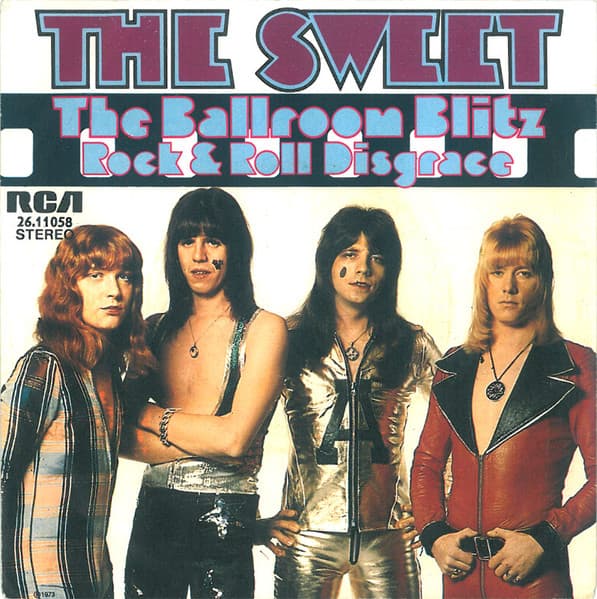
A Riot Disguised as Glamour, Where Chaos Became One of Rock’s Most Electrifying Anthems
When Sweet unleashed “The Ballroom Blitz” in 1973, the song exploded far beyond the boundaries of glam rock spectacle. Released on the album Desolation Boulevard in several international markets, the single became a major hit across Europe and later stormed the American charts, eventually reaching the Top 5 on the Billboard Hot 100. But statistics alone never explained its endurance. What truly kept “The Ballroom Blitz” alive across generations was its sense of danger. Even now, more than fifty years later, the record still sounds like a stage collapsing under flashing lights and adrenaline.
The remarkable thing about the song is that its legendary opening was rooted in something disturbingly real. During a live performance in Scotland in early 1973, members of Sweet reportedly faced a hostile crowd that began throwing bottles at the stage. Instead of fading into embarrassment or retreating from the incident, songwriters Nicky Chinn and Mike Chapman transformed the chaos into mythology. The result was not merely another glam-rock single engineered for radio. It became a theatrical reenactment of panic itself.
From the first shouted roll call, the record moves like a runaway train. “Are you ready, Steve?” remains one of the great openings in rock history because it immediately places the listener inside the room. There is no slow introduction, no careful buildup. The song throws open the doors and drags the audience straight into the frenzy. Drums crash forward with military precision while the guitars slash through the mix with sharp, metallic confidence. Yet underneath all the glitter and velocity lies something darker: a portrait of a crowd losing control.
That tension is what separates “The Ballroom Blitz” from many glam-era hits that depended solely on flamboyance. The song captures the unstable relationship between performers and audiences, where admiration can suddenly turn volatile. The lyrics feel fragmented, breathless, almost cinematic in the way they describe confusion and movement. It is less a traditional narrative than a sensory experience. The listener does not simply hear the event; they feel trapped inside it.
Vocally, Brian Connolly delivered one of the defining performances of the decade. His voice balanced theatrical swagger with genuine urgency, giving the song an edge that many polished glam productions lacked. Around him, the band played with absolute commitment, creating a sound that felt massive without losing its rawness. There is glitter here, certainly, but there is also aggression. That combination helped the song survive long after glam rock’s commercial peak faded.
Over time, “The Ballroom Blitz” became more than a hit single. It evolved into a cultural shorthand for beautiful disorder. Films, sports arenas, television broadcasts, and generations of cover bands have all borrowed its explosive energy because the song embodies a universal feeling: the thrill of losing control in a crowded room full of noise and light.
But beneath the spectacle, the song also preserves a strangely human truth about rock and roll itself. Live music has always carried unpredictability. One moment can swing from celebration into chaos without warning. Sweet captured that instability in under four minutes, turning fear into rhythm and confusion into immortality. Few records from the glam era still feel this alive. “The Ballroom Blitz” does because it was never pretending to be dangerous. It already was.