
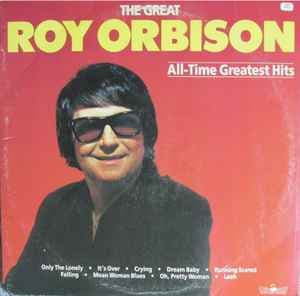
A Monument Built from Loneliness, Desire, and the Echo of an Unforgettable Voice
When Roy Orbison released The All-Time Greatest Hits of Roy Orbison in 1977, the compilation did more than gather old successes into a double album—it restored a legend to the center of American musical memory. Issued by Monument Records, the collection revisited the astonishing run of singles Orbison recorded during the early 1960s, many of which had already become permanent fixtures of popular music. Songs like “Only the Lonely,” “Crying,” “In Dreams,” “Blue Bayou,” and “Oh, Pretty Woman” had each carved their own place in chart history years earlier, with “Oh, Pretty Woman” famously reaching No. 1 on the Billboard Hot 100 in 1964. Yet by 1977, hearing them together in one sweeping anthology revealed something deeper: this was not merely a hit collection, but a portrait of emotional isolation rendered in operatic form.
What separated Roy Orbison from nearly every vocalist of his era was his refusal to perform masculinity in the conventional rock-and-roll sense. While many singers projected swagger, rebellion, or seduction, Orbison stood almost motionless behind dark sunglasses, singing not about conquest but vulnerability. His greatest recordings sounded like private confessions broadcast into the night. There was an uncommon dignity in his heartbreak. He did not beg dramatically; he endured. And that emotional restraint became one of the defining characteristics of his music.
Listening to The All-Time Greatest Hits of Roy Orbison feels less like revisiting radio nostalgia and more like walking through a cathedral of memory. The sequencing captures the full architecture of Orbison’s artistry: the trembling loneliness of “Only the Lonely,” the unbearable surrender inside “Crying,” the dreamlike terror and longing of “In Dreams.” These were not simple pop songs. They were miniature emotional films, built with orchestral crescendos, sudden key changes, and vocal performances that seemed to rise beyond earthly limitation.
Orbison’s voice remains one of the most singular instruments ever recorded in popular music. He could begin a verse in a near whisper and climb effortlessly into an almost operatic falsetto without sacrificing intimacy. That ability gave his songs their haunting emotional tension. Even at their most dramatic, they never felt theatrical in a false sense; they felt painfully real. His recordings carried the sound of a man trying to hold himself together while emotion threatened to overwhelm him completely.
By the time this compilation arrived in 1977, popular music had already shifted through psychedelic rock, singer-songwriter confessionals, and arena spectacle. Yet Orbison’s recordings sounded untouched by trends. They belonged to a different emotional universe altogether. Younger audiences discovering the album during the late 1970s encountered something timeless: songs unconcerned with fashion, built instead on universal human ache. That endurance explains why generations of artists—from Bruce Springsteen to Chris Isaak and k.d. lang—would later draw inspiration from Orbison’s emotional openness and cinematic songwriting style.
There is also a quiet tragedy embedded within this collection. Many of these songs emerged before the devastating personal losses that would later mark Orbison’s life, including the deaths of his wife and two sons. Yet even in the earlier recordings, there is already a profound understanding of grief and impermanence. It is as though his voice carried sorrow before sorrow fully arrived. That quality gives the compilation its extraordinary emotional weight decades later.
Ultimately, The All-Time Greatest Hits of Roy Orbison endures because it captures an artist who transformed loneliness into grandeur. Orbison did not simply sing sad songs; he elevated heartbreak into myth. These recordings remain timeless not because they remind listeners of the past, but because they continue to articulate emotions most people spend their lives struggling to name.