
A Man Calls Into the Darkness, and Love Answers Back
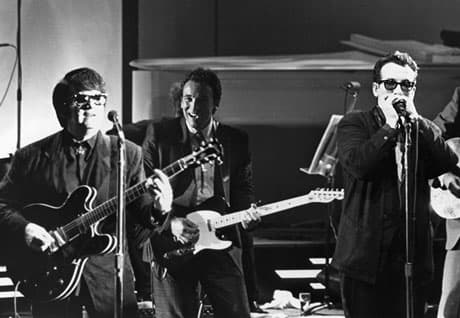
When Roy Orbison stepped onto the stage for the legendary 1987 television special Black & White Night, he did not arrive as a relic of rock and roll’s golden age. He arrived as one of its last great witnesses. Among the many songs resurrected that evening, “Leah” carried a particularly haunting resonance — a dramatic ballad originally released in 1962 on the album Crying, where Orbison’s voice once again transformed loneliness into something almost mythic. Though never one of his towering chart juggernauts like “Only the Lonely” or “Crying,” the song became a cherished deep cut among devoted listeners, admired for its emotional architecture and cinematic sense of yearning. In the context of Black & White Night, performed beside an all-star assembly of musicians and admirers, the song felt less like a nostalgic revisit and more like a man reopening an old wound under stage lights.
What makes “Leah” endure is the way it inhabits the border between dream and despair. Orbison was uniquely gifted at portraying love not as comfort, but as distance — unreachable, shimmering, almost supernatural. In this song, Leah is less a conventional romantic figure than an obsession carried across darkness and silence. The lyrics move like a lonely traveler wandering through emotional wilderness, calling out a name that may never answer back. Few singers in American popular music understood isolation with the same operatic intensity as Orbison. He did not merely sing heartbreak; he elevated it into tragic theatre.
The arrangement itself reflects that emotional architecture. The melody rises slowly, almost cautiously, before Orbison’s voice ascends into those unmistakable high registers that seemed to suspend time itself. Unlike many early-1960s pop recordings built for immediacy, “Leah” unfolds patiently. There is space in the song — space for longing, memory, and uncertainty. The orchestration never overwhelms him; instead, it shadows him like moonlight across empty pavement. Listening closely, one hears the influence of old torch songs, country balladry, and even the emotional grandeur of classical aria construction. Orbison often stood outside the conventions of rock music because his emotional vocabulary was simply larger than most of his contemporaries’.
By the time of Black & White Night, that emotional gravity had deepened. Orbison’s voice had aged into something even more vulnerable and majestic. Surrounded by artists who revered him — including figures from across rock, country, and folk traditions — he sang “Leah” not as a youthful lament, but as testimony. The performance carried the weight of survival. There is a profound difference between a young man singing about loneliness and an older man who has lived through grief, loss, and silence doing the same. Orbison knew tragedy intimately by then, and every phrase in the performance seems touched by experience rather than performance alone.
That is ultimately why “Leah” remains so affecting decades later. The song does not chase trends or demand attention through spectacle. It survives because it speaks to the timeless human instinct to keep calling out for someone, even when the night offers no certainty of reply. In Orbison’s hands, longing became almost sacred — and songs like “Leah” remind us that some voices are remembered not because they were loud, but because they understood sorrow so completely.