
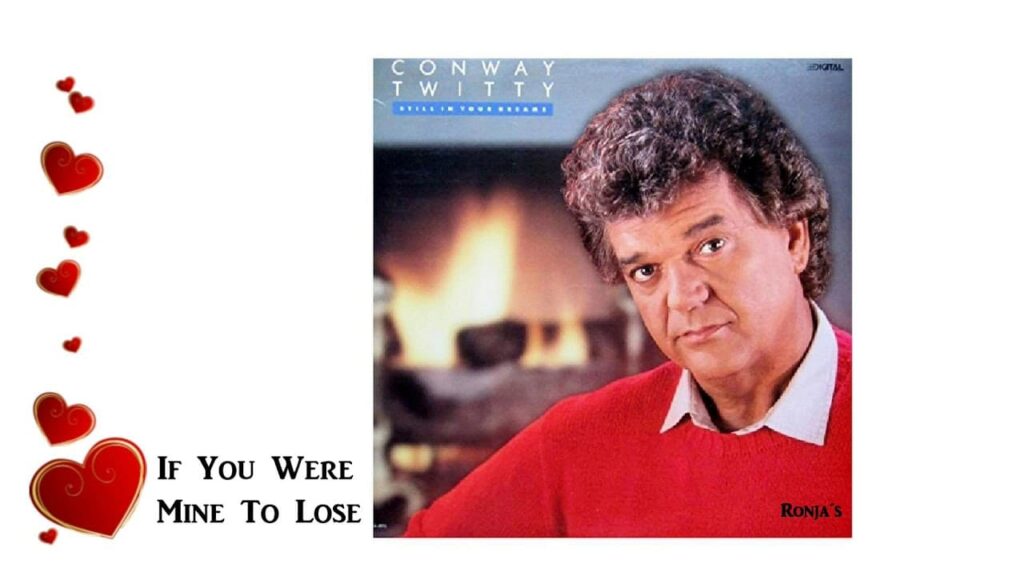
Love becomes most fragile when it finally feels real enough to be lost
When Conway Twitty recorded If You Were Mine To Lose, he was deep into the defining years of his country career, a period that saw him dominate the genre’s charts with remarkable consistency. Released as a single in 1985, the song climbed to No. 1 on the Billboard Hot Country Singles chart and later found its place on the album Don’t Call Him a Cowboy. By this stage, Twitty was no longer simply a hitmaker, he was an institution, a voice synonymous with emotional precision and romantic storytelling.
At first listen, If You Were Mine To Lose appears to follow a familiar country blueprint. A man reflects on love, acknowledging its value through the fear of losing it. Yet beneath that surface lies a more intricate emotional architecture. The song does not celebrate possession or certainty. Instead, it explores a paradox. The narrator suggests that the true weight of love only reveals itself when one accepts its vulnerability. To have someone fully is to risk everything.
This thematic tension is where Conway Twitty’s interpretive genius becomes unmistakable. His vocal delivery does not rely on dramatic flourishes. It is measured, controlled, and deeply intimate. Each line feels lived rather than performed, as though he is discovering the sentiment in real time. There is a subtle hesitance in his phrasing, a reflective pause between words that mirrors the emotional hesitation embedded in the lyrics themselves. Twitty was a master of this restraint. He understood that in country music, silence and space can often speak louder than orchestration.
Musically, the arrangement supports this introspection with understated elegance. Gentle steel guitar lines drift through the background, while the rhythm section maintains a steady, almost heartbeat-like presence. Nothing distracts from the central confession. The production allows the song to breathe, reinforcing the idea that this is not a grand declaration, but a quiet realization. In this sense, If You Were Mine To Lose stands in contrast to more overtly dramatic love songs of its era. It does not demand attention. It earns it through sincerity.
There is also a broader cultural resonance to consider. By the mid-1980s, country music was navigating a delicate balance between traditional storytelling and contemporary polish. Conway Twitty occupied a unique position within that landscape. He bridged generations, carrying forward the emotional directness of classic country while embracing modern production techniques. Songs like If You Were Mine To Lose exemplify that balance. They feel timeless, yet unmistakably rooted in their moment.
Ultimately, the song endures because it articulates a truth that transcends genre. Love is not defined by certainty, but by risk. In giving one’s heart, there is always the possibility of loss. Conway Twitty does not shy away from that reality. Instead, he leans into it, allowing the listener to sit within that fragile space where devotion and doubt coexist. It is in that quiet, uncertain territory that If You Were Mine To Lose finds its lasting power.