
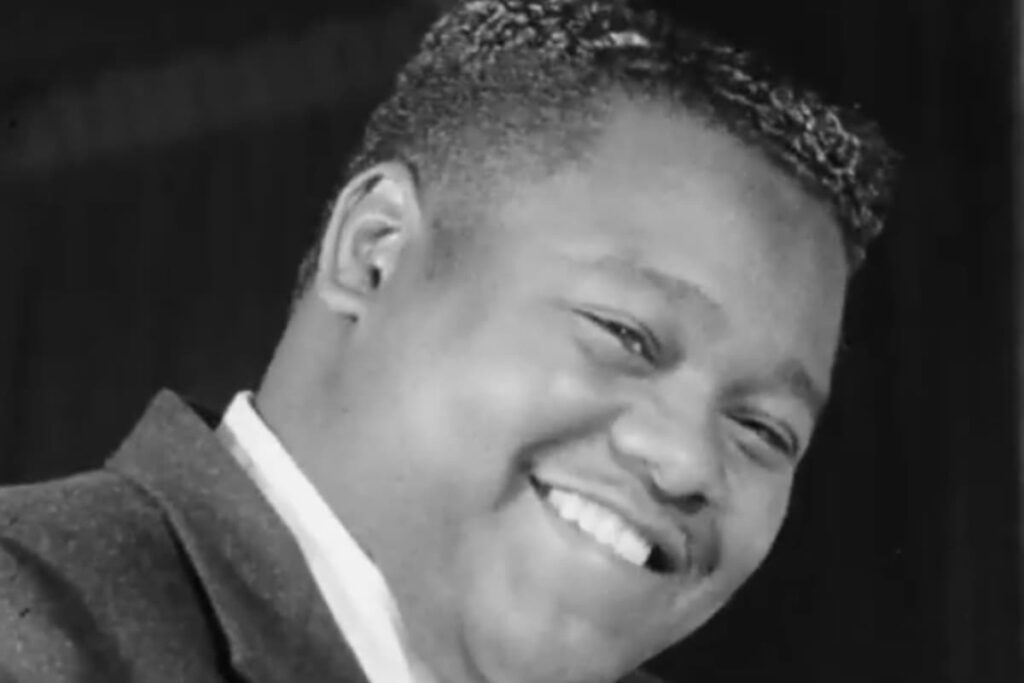
A joyous rhythm where the piano becomes both heartbeat and invitation to dance
Within the vibrant surge of early rock and roll, Fats Domino stood as a quiet architect of joy, crafting songs that did not merely play but moved bodies and lifted spirits. Domino Stomp (Twistin’ The Stomp), associated with the kinetic energy of his early 1960s recordings and performances, reflects that spirit with unfiltered exuberance. While not among his most commercially dominant singles compared to his chart-topping run in the previous decade, the track belongs to the extended musical landscape shaped around albums like Twistin’ the Stomp, where Domino embraced the dance crazes of the era while staying rooted in his unmistakable New Orleans sound.
At its core, Domino Stomp (Twistin’ The Stomp) is less a conventional song and more a celebration of rhythm as communal language. The title itself signals movement before a single note is heard. “Stomp” evokes something grounded, earthy, almost primal, while “twistin’” connects it to the early 1960s dance phenomenon that swept across American youth culture. Domino, however, does not chase trends so much as absorb them into his own musical vocabulary. His piano remains the anchor, rolling and percussive, echoing the boogie-woogie traditions that defined his earliest hits.
Listening closely, one hears how Fats Domino transforms simplicity into something enduring. The structure is direct, almost deceptively so, yet every note carries intention. His left hand lays down a steady, almost hypnotic pulse, while the right hand dances lightly above it, creating a dialogue between rhythm and melody. It is this interplay that gives the track its irresistible momentum. The music does not demand attention through complexity; it earns it through feel.
There is also an understated cultural significance embedded within the track. By the time Domino Stomp (Twistin’ The Stomp) emerged, rock and roll had already begun to evolve, splintering into new styles and identities. Yet Fats Domino remained a bridge to its origins. His sound carried the DNA of rhythm and blues, New Orleans jazz, and gospel warmth. In embracing the twist era without abandoning his roots, he demonstrated a rare adaptability, proving that authenticity and evolution need not be at odds.
Emotionally, the song offers something profoundly human. It is not burdened by longing or heartbreak, themes that dominate so much of popular music. Instead, it captures a fleeting but essential experience: collective joy. The kind found on crowded dance floors, in shared laughter, in the simple act of moving to a beat that feels larger than oneself. Domino’s genial vocal presence, often more felt than overtly emphasized here, reinforces that sense of inclusivity. He does not perform above the listener; he invites them in.
Decades later, Domino Stomp (Twistin’ The Stomp) remains a testament to the enduring power of rhythm. It reminds us that before music was analyzed, archived, or historicized, it was lived. And in the rolling cadence of Domino’s piano, that life continues to echo, urging each new listener to join the dance.