
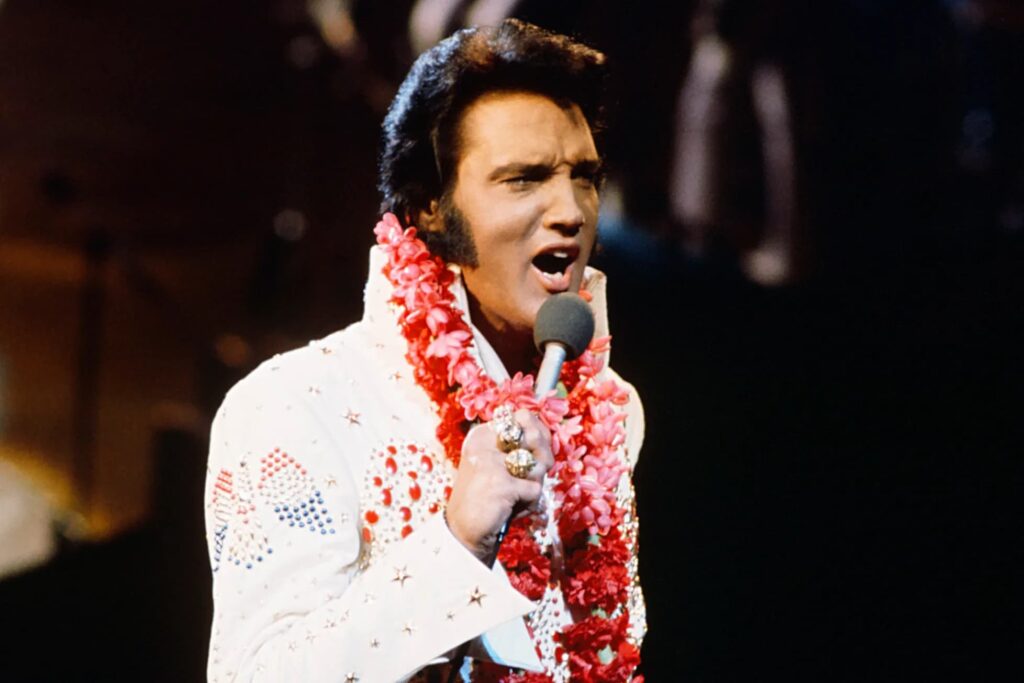
Global broadcast where spectacle met solitude, revealing a legend both larger than life and quietly human
When Elvis Presley took the stage for Aloha from Hawaii via Satellite in 1973, the moment transcended the boundaries of a typical concert performance. Broadcast to a global audience and later released as the album Aloha from Hawaii via Satellite, the recording achieved remarkable commercial success, reaching No. 1 on the Billboard 200 in the United States. It marked not only a technical milestone in live broadcasting but also a defining chapter in Presley’s late career, where grandeur and introspection coexisted in fragile balance.
By this stage, Elvis Presley was no longer the rebellious figure who had once shocked America’s cultural foundations. He had become something more complex. A symbol. An institution. Yet beneath the ornate jumpsuits and the meticulously orchestrated stage production, there remained an artist grappling with time, legacy, and identity. The Aloha from Hawaii performance captures that duality with striking clarity.
The setlist itself functions almost like a retrospective narrative. Songs such as Burning Love, Something, and Can’t Help Falling in Love are not merely performed. They are revisited, reframed through the lens of experience. His voice, deeper and more weathered than in his youth, carries a different emotional weight. There is less urgency, but more gravity. Each note feels deliberate, as though Presley understood the historical significance of the moment even as it unfolded.
What distinguishes Aloha from Hawaii via Satellite is not simply its scale, though the scale is undeniable. It is the intimacy that somehow survives within that scale. Presley’s vocal delivery often feels inward, almost reflective, despite the vastness of the audience beyond the cameras. This tension between public spectacle and private emotion becomes the true narrative of the performance.
Musically, the arrangements are expansive, blending rock, pop, gospel, and orchestral elements into a cohesive whole. The band, tight and responsive, provides a foundation that allows Presley to move fluidly between styles. Yet it is in the quieter moments where the performance reveals its deepest truths. Ballads become confessions. Pauses become statements. Silence itself carries meaning.
There is also a symbolic dimension to the setting. Hawaii, often imagined as a place of escape and paradise, becomes a backdrop for a performance that subtly questions the cost of fame and endurance. The satellite broadcast, reaching across continents, reinforces Presley’s status as a global figure. At the same time, it underscores a certain distance, a sense that the man at the center of it all is both everywhere and nowhere at once.
In retrospect, Aloha from Hawaii via Satellite stands as one of the last great unified statements of Elvis Presley’s artistry. It is not merely a concert. It is a document of transition. A moment where the myth and the man briefly align, allowing the audience to glimpse not just the King of Rock and Roll, but the individual behind the crown.